1. Legumes are plants of the family Leguminosae, a large group characterised by the bearing of rows of seeds in pods, and roots that bear nodules inhabited by bacteria that convert atmospheric nitrogen into compounds that can be absorbed by plants. Lentils are a type of legume edible by humans, as are peas and beans. Edible legumes are collectively known as pulses. Clover is a kind of plant not generally considered edible by humans, but which bears its seeds in rows in pods and has nodules bearing nitrogen-converting bacteria. From this information it follows that :
2. A girl and a boy are sitting next to each other on a park bench. The girl says “I support the Demons”. The boy says “I support the Panthers”. It is known that the girl supports one of these two teams, the boy supports the other, and that at least one person is lying. 2.Which one of the following is correct?
3. Consider the following table that shows how often adults in a particular western country attend church
CHURCH ATTENDANCE BY ADULTS
never attend 33.5%
less than once a year 17.4%
once or twice a year 15.9%
several times a year 9.0%
about once a month 2.6%
two or three times a month 3.7%
nearly every week 4.7%
every week 9.8%
several times a week 2.8%
every day 0.6%
According to this informations,
4. Three glasses, labelled X, Y and Z, are on a table. Each is exactly half full of water. Two of the glasses can each hold twice as much as the third one. The small glass may be X or Y or Z. Half of the water in glass X is poured into glass Y. Then, half of the water now in glass Y is poured into glass Z. Finally, half of the water now in glass Z is poured into glass X.
5. A melanoma is a type of skin cancer.
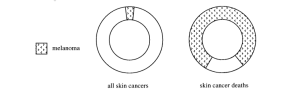
Together, these two diagrams indicate that
6. This diagram indicates that
7. Out of 28 cases of people who have been found guilty of an offence and then subsequently proved innocent by evidence from DNA testing, 24 had been positively identified in police line-ups or ‘mug shots’ as being the criminals concerned. Which of the following is best supported by this information?
8. In Islandia, bullfighting has been carried on over centuries. Not everyone is in favour of bullfighting. There are equal numbers of men and women in Islandia. Ten per cent of Islandians are against bullfighting. Of these, seven out of ten are women. All others like bullfighting. The number of
9. Suppose that of the following four statements, just one of the statements is actually true.
Statement I None of these four statements is true.
Statement II The statement above is true.
Statement III The statement above is false.
Statement IV The statement above is false.
The true statement must be
SECTION 2 : Interpersonal Understanding
Questions 1 and 2 The following conversation is between a mother and her adopted son.
The child has been recently adopted and is about ten years old. He has a history of setting fires. Mother: Do you know why your birthmother arranged for you to be adopted? Child: Because I was bad. Mother: What did you do that was so bad? Child: I set a fire in the basement. Mother: How do you think your birthmother felt when she saw the basement on fire? 5 Child: She was scared. Mother: How do you think she felt after the fire was put out? Child: I don’t know. Mother: I think maybe she was scared in a different way. She was scared because she could see that if you were setting fires you needed help and she didn’t know how to give you the help you needed. So she found a way to see that you had parents who could give you the help that she didn’t know how to give.
1. How does the mother respond to her adopted son’s perception that he did something bad?
2. What does the mother seem to believe will be most helpful for her adopted son at this point?
Questions 3 – 6
The following extract is taken from a text that explores different individuals’ experiences of illness.
The patient has undergone major abdominal surgery.
If there is a distinction between experiencing and remembering, it is lost on doctors. When the chief
resident arrived, I repeated my request for pain killers. He said pain was an important indicator of
what was going on inside me and they needed to know when and where I hurt. He could apply a
local pain killer where the tube was inserted, which would help with the pain of the insertion; for
the rest, he would give me something to relax me that would also erase my memory of the pain. I
agreed to all this — again, I seemed to have no choice — but thought, ‘Great, I’ll suffer but I won’t
remember it and that’s supposed to make it okay?
3. How does the patient feel as a result of the consultation with the doctor?
4. How does the doctor respond to the patient’s request for pain killers?
5. What is the patient most concerned about ?
6. The doctor could have alleviated the patient’s concerns by
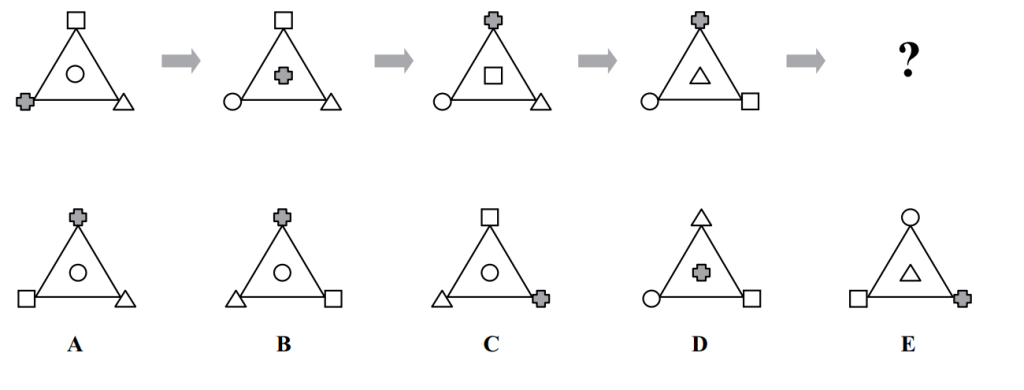
Questions 1 − 6 : Next in the Series For each of the following items, select the alternative (A, B, C, D or E) that most logically and simply continues the series
1.